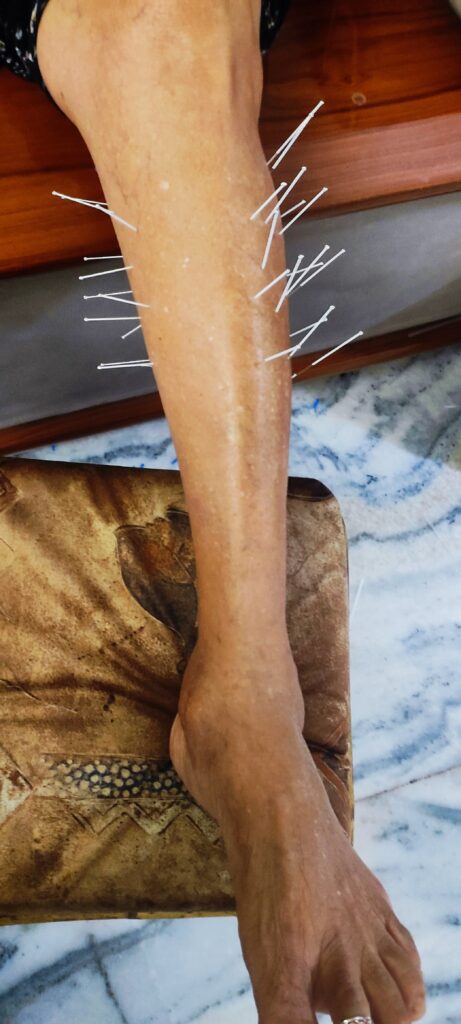
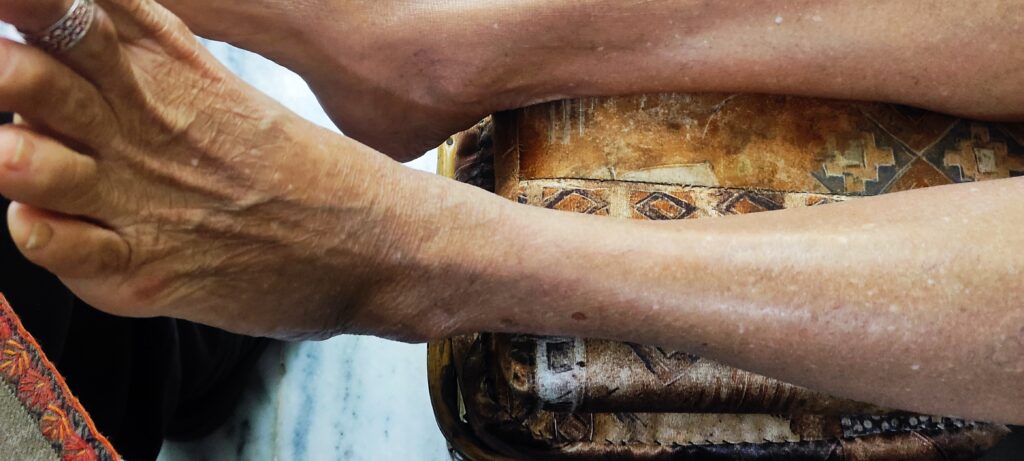
A 78 year old lady presented with symptoms of severe pain in the left foot since 1 year and 2 months. She had sustained a fracture of her left foot after a fall in the bathroom 1 year 2 months ago and had undergone open reduction and fixation for the same. Initially she had pain due to surgery but this persisted and became even more progressive and crippling. It was also present at rest. She had difficulty standing and walking and was unable to do her household tasks. Most of the time she was confined to her bed. Maximum pain was around the ankle but it extended down to the dorsum of her foot and up her leg to the knee. Even the mildest touch was painful as also any movement of the foot. There was slight swelling and discolouration over the dorsum of the foot and the whole left leg looked shiny. There was also increased sensitivity to cold and she had to keep her left leg covered. She looked anxious, depressed and tearful.
Clinical examination revealed mild discolouration and swelling over the dorsum of the foot and allodynia (pain on touch) especially around the ankle. Upward and downward movement of her foot was restricted and painful.
Postoperative X ray of the foot confirmed good bony alignment. Analgesics were not effective in relieving her pain and physiotherapy was very painful.
Based on history and clinical examination a diagnosis of Chronic Regional Pain Syndrome 1 was made and she was recommended a treatment plan of dry needling, anticonvulsants, tricyclic antidepressants, a short course of anti-inflammatory drugs, tramadol (analgesic), physiotherapy and psychological support.
Dry needling sessions were started and was given on alternate days. There was marked relief in pain, swelling and mobility after the 2nd session of dry needling. She received a total of 5 sessions over a period of 9 days during which period she showed progressive improvement in pain and functionality. She had 90% relief of pain after 4 sessions of dry needling. She started regular walks inside the house and even ventured into the kitchen to do some cooking. She became more cheerful and positive in her outlook. Tramadol was tapered but the rest of the medicines were continued.
She has been advised follow up after 2 weeks for re-assessment and few more sessions.
What is Chronic Regional Pain Syndrome (CRPS)?
CRPS is a chronic painful condition involving the extremities like arms or legs that can occur after an injury and it persists long after the injury has healed. It can also occur after fractures, surgery, removal of plaster casts and even after stroke. There are two types of CRPS. CRPS 1 occurs after any injury or trauma and CRPS 2 occurs following nerve injury. This lady had CRPS 1 following surgery for fracture of her ankle bones.
The main symptoms of CRPS are unrelenting pain and stiffness with a loss of functionality of the extremity. There is increased sensitivity to touch as well as temperature changes especially to cold. The skin over the limb may shiny and there could be disolouration and swelling as well. There could be psychological changes because of severe pain and loss of functionality and anxiety and depression are often present.
The diagnosis of CRPS is based on history and clinical examination and there is no single test that can confirm it. The Budapest criteria for diagnosing CRPS is a useful tool. It is based on symptoms and signs such as pain, increased sensitivity to touch and pain, changes in temperature and colour, swelling and decreased mobility.
There is no magic bullet to treat CRPS and a multimodal strategy is necessary. The pain of CRPS does not generally respond to regular analgesics and physiotherapy can be very painful. We need to give drugs that treat nerve pain like tramadol, pregabalin and antidepressants. Dry needling is a very useful modality to treat not only pain but also in improving the mobility and the function of the limb. This lady who suffered pain and dysfunction for more than a year responded to dry needling in a matter of a few days. With relief of pain after dry needling, physiotherapy and rehabilitation becomes more feasible. Reassurance and psychological therapy also need to be part of the treatment strategy.
A very difficult condition to treat but it is possible.
Listen in to her story…….